
Context
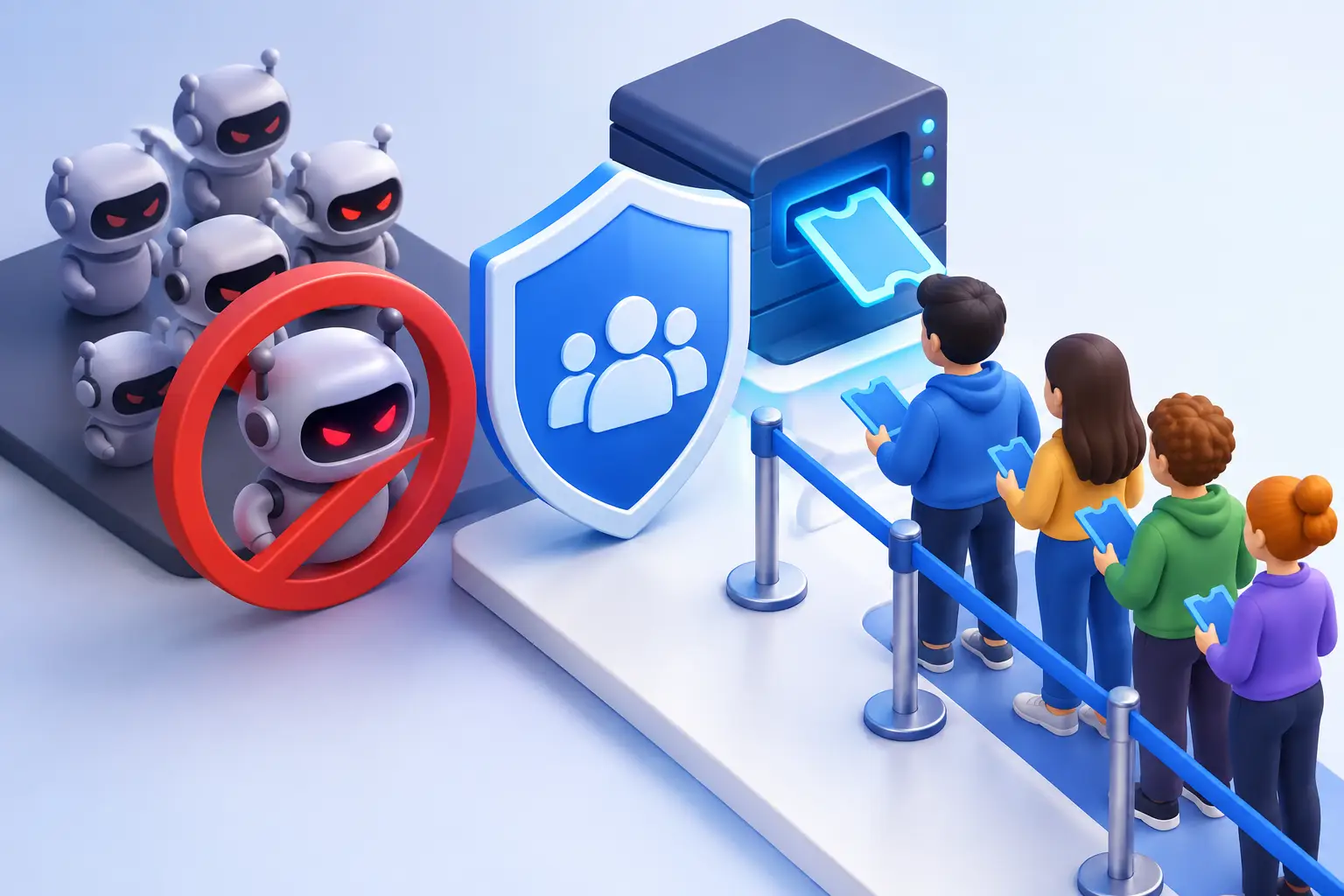
Ticket scalping bots can leave your sale looking successful while genuine fans struggle to buy. For your ticketing team, the difficult question is whether apparently separate purchases belong to the same operation. An October 2026 US enforcement complaint alleges that a ticket broker circumvented purchasing controls to exceed event limits; the FTC currently lists the case as pending. Effective protection means examining how tickets are acquired, connecting suspicious attempts, and keeping legitimate purchases moving.
TL;DR
- Ticket scalping bots automate attempts to acquire tickets for resale. Purchase limits lose their effect when an operator can repeatedly buy through different accounts.
- Investigate coordinated behaviour across the buying journey. A fast checkout or shared IP address alone is insufficient evidence.
- Enforce eligibility and quantity rules on the server at reservation and purchase, including requests arriving directly through APIs.
- Measure confirmed limit violations alongside legitimate checkout completion, customer complaints and overturned blocks.
- Treat queue entry, unpaid seat holds and completed purchases as distinct problems with connected evidence.
How Ticket Scalping Bots Work
What is ticket scalping?
Ticket scalping means acquiring tickets for resale, generally seeking a markup on scarce or desirable inventory. Ticket scalping bots automate parts of that acquisition process, such as checking availability, selecting seats and submitting purchase attempts.
For a ticketing operator, the actionable concern is whether someone is defeating your allocation rules. A resale listing alone does not establish how a ticket was acquired, and a completed payment does not establish that the purchase respected your limits.
How ticket bots work across the purchase journey
Think of the attack as a buying workflow. An operator prepares accounts and purchasing details, watches for availability, then uses parallel sessions to pursue tickets. Automation may operate through a browser or submit requests to the application endpoints behind it.
The weakness can be in how otherwise valid actions combine. An account buys within its allowance; another account does the same. If those accounts belong to the same operation and your rules apply per customer, checking each account separately misses the violation.
OWASP describes scalping as abuse of a sensitive business flow: automated purchasing can deny other customers access even when the application has no conventional software exploit.
Bots can also work alongside human buyers. The FTC's complaint against REPS alleges coordinated use of purchasing accounts, virtual payment cards, proxy services and multi-session browsers by employees. Those allegations illustrate why your investigation should examine connected purchasing activity rather than assume every problematic order comes from an unattended script.
Separate purchased tickets from unpaid holds
Tickets held in a cart are not yet sold. Repeated reservations can make seats unavailable without producing completed purchases, a ticketing misuse case covered in OWASP's process-timing guidance.
Distinguish that activity in your reporting. Purchased inventory exceeding customer limits needs an allocation investigation. Repeated unpaid holds need reservation-expiry and reacquisition controls. Combining them into a single “bot traffic” total hides where the intervention belongs.
Why Attackers Target Ticket Sales
Scarcity creates a reason to automate
An event has finite capacity. When buyers value access more highly than the initial sale price, an operator has an incentive to secure inventory for resale. Automation provides a way to repeat buying attempts across accounts and sessions.
Presale eligibility can become part of the same operation. If access is allocated through registrations, assess whether apparently separate registrations represent independent customers. A successfully redeemed presale code proves the code worked; it does not settle whether the buyer accumulated access against your rules.
The business cost extends beyond ticket revenue
A scalped ticket may still generate primary-sale revenue. Treating every such purchase as lost revenue would overstate the business case.
Build the case around costs and outcomes you can demonstrate: support contacts from excluded fans, staff time investigating coordinated orders, cancellation and reissue work, and promoter concerns about who obtained access. Include infrastructure costs where you can attribute them to unwanted activity.
Consider an illustrative sale in which orders complete normally, but support receives complaints about unavailable seats. Investigation then finds related accounts repeatedly acquiring the same premium inventory. The revenue dashboard alone would not reveal the allocation problem.
For a CISO or risk leader, the budget question is which controls reduce those failures at an acceptable cost to genuine customers. For engineering, that means identifying the exact point where a suspicious attempt becomes a reservation or a confirmed order.
How to Prevent Ticket Scalping Bots
Define the purchase rule you intend to enforce
Start with an explicit policy. Does the allowance apply to an account, a customer, a household or a payment method? Does it cover purchases across sale phases? How should cancelled orders affect the remaining allowance?
Resolve those questions with ticketing operations before translating them into controls. Otherwise, engineering may enforce an account limit while the promoter expects a customer limit.
Document legitimate exceptions, including group bookings and assisted purchases. Give support a way to review a decision against the actual policy.
Enforce rules where tickets are allocated
Map the routes that create reservations, redeem eligibility and confirm purchases. Include mobile clients and partner integrations as well as the website.
Require server-side checks at those points. A quantity selector in the browser cannot be your final authority. Your application should validate the requested event, entitlement, remaining allowance and reservation ownership before committing the action.
Test simultaneous requests as well as repeated ones. A quota check and its update should be coordinated so concurrent purchases cannot each consume the same remaining allowance. Make retry handling explicit: a network retry should not create an additional order.
Keep these checks consistent across every supported purchasing channel.
Turn warning signals into investigations
Use a combination of observations to decide what deserves scrutiny. The table below is a suggested investigation framework, not a set of automatic blocking rules.
A shared connection can belong to a household, workplace or mobile network. Similar timing is also expected when a popular sale opens. Ask whether the combined evidence explains a policy violation before taking action.
Where you use payment references, work with appropriate tokens or provider references rather than copying raw card details into investigation logs.
Limit repeated holds without breaking checkout
Set reservation expiry on the server and test that inventory actually returns to availability. Then test what happens when the same activity immediately tries to reserve it again.
Account for legitimate payment authentication and recoverable errors. A customer completing a payment challenge should not encounter an unexplained expired reservation while their payment is still being resolved.
Define how the system reconciles a late payment result with released inventory. Your team needs an explicit recovery path, not conflicting “payment successful” and “ticket unavailable” messages.
Use verification where it resolves uncertainty
Choose the response according to the evidence and the action at risk. An uncertain attempt may warrant additional account verification. A clearly invalid entitlement should be rejected. Repeated suspicious reservations may justify a temporary restriction.
Passing a challenge should not reset a customer's purchase allowance or override an eligibility failure. Verification and allocation rules serve different purposes.
Keep queue protection focused on admission. Your downstream reservation and checkout checks still need to enforce the sale's rules. Kairal's separate guide covers stopping scalpers in an online queue; this article focuses on what happens when attempts reach ticket allocation.
Test the experience of legitimate buyers
Ticket bot prevention needs a customer-impact test alongside an attack test.
Exercise mobile checkout, shared networks, accessibility tools, returning customers and interrupted payment flows. Test permitted partner routes too. Record which control made each decision so support can explain an outcome and engineering can correct it.
Before increasing enforcement, review a sample of flagged activity with fraud and support teams. Establish what would trigger a rollback and who can authorise it during the sale.
Stop Ticket Scalping Bots Before It Costs You
If you are deciding how to stop scalping bots before the next release, begin with the last sale's reservations and completed orders. Identify where suspicious activity obtained access, where it became inventory, and where your team lacked enough evidence to decide.
Assign an owner to each gap. An unprotected reservation route is an engineering issue. An unclear household allowance needs a business decision. A support team unable to explain blocks needs usable decision records.
Track outcomes that make ticket scalping prevention assessable:
- Confirmed allocation violations: tickets acquired beyond your rules, after review.
- Reservation pressure: inventory held without payment and repeated reacquisition.
- Legitimate checkout completion: completion among an agreed, consistently defined customer group.
- Decision quality: reviewed blocks overturned and related customer complaints.
- Operational effort: time spent investigating, resolving and communicating incidents.
Define the denominator for every rate. Removing automated sessions can change an overall conversion rate without improving a genuine customer's chance of buying.
Compare similar events where possible, and record differences in demand, pricing, inventory and sale design. Use your own operating costs to build the budget case. Avoid attaching an assumed financial value to every blocked request.
How Kairal Can Help
Kairal's ticketing protection assesses requests at protected login, seat-selection, reservation and checkout endpoints. It provides session linking and session-level rate controls to help your team evaluate repeated activity across attempts.
For an investigation, Kairal's Events view shows the route, risk score and action taken, while Sessions provides context around related activity. That gives your team evidence to examine when a sale produces repeated reservations or suspicious purchasing attempts.
Kairal Business Defense, currently in early access, adds sign-up scoring for investigating presale-account farming. Confirm the scope of early-access features when planning your deployment.
Your ticketing application still needs clear allocation rules, correct reservation handling and a review process for disputed decisions. Kairal can support that work by assessing activity where access to tickets is decided.
Talk to Kairal about your ticket-buying flow to identify which routes need protection and what evidence your team needs before the next sale.